


New Routes for Old
By Bob Milward
The Psychlist
1976, 37 years ago, the KMC team of Norman Ingham and I approached Llech Ddu in the Carneddau. We had noticed the large unclimbed buttress at the left side of the crag. It had a lower tier of about 100’, a grass arête of another 100’ and an upper tier of blunt, bulging overhangs perhaps another 120’, really impressive. We walked up to a groove in the lower tier and climbed it free at about HVS. The initial groove (about 70’) was very loose and I remember, while bridging up it, quite suddenly, I found a rock in my right hand, weighing about as much as a car battery. I managed to guide it past my leg and luckily it did not snag any gear on its way down. (Norm, having played this game before, was hiding round the corner to the right, out of the line of fire). I exited up right and belayed on a large, thin, hollow flake, with a belay on the wall above. By this time the nervous energy between us was rather high. Some turf hid the flake top, so when Norm was belayed sitting on it, before I set off up the next pitch, I kicked the flake and it rang like a bell. Boy did Norman shriek! A little VS section brought us to the grass ridge which we followed to the upper tier. I cannot remember if we tried any cleaning, but we escaped off left on the grassy band. I think we checked out the rappel possibilities above the top tier. Later we found out the bottom tier had been climbed some years before.
A week or so later, we came back with three ropes. It took about 70 ft. of rope to tie round a low outcrop and put the knot near the edge. We then rapped on two 50 metre ropes over the point of the overhangs into mist. As soon as you clear the main overhang you are about 15 feet out from the rock. By the time you are level with the belay you are well over 20 feet away. The rappel finally meets the grassy ridge near the bottom of the second pitch. By this time we had fine drizzle and we were rather gripped. After retrieving all our ropes, we went home.
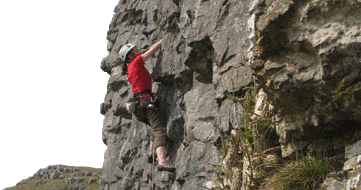
The next time I think we approached by abseil, but I climbed the big pitch with tension or sitting on a lot of gear while cleaning. Our original intent was to go directly over the overhangs up the crest of the buttress, but in the event we followed the natural easiest line. The first 25 ft. groove was straight forward, vertical mud and turf leaning left, then there was an off balance resting spot (see photo) where I found a hole which I enlarged to give a thread, then a 15 ft steep wall to the roof. At the roof I was on aid. I remember a sort of depression with opposing nuts. However, I was looking to go straight over the roof. When you are on full aid under a roof, you hang a little like you are in a deck chair. In this position I touched the roof, looking for my next pin when, silently, but with incredible speed a block, roughly a cube of 2ft x 2 ft (approx. 1200 lbs.) with a pointed bottom, dropped past me, missing my guts by a hairs’ breadth. Six inches further over and I would have been disembowelled. The easier way lead to the right and I carried on until I found an amazing jagged hole which took six inches of large steel channel peg. From here I tensioned down right along the lip of an overhang. The position at this point is exciting, since lowering off would not reach the ground. A few feet of easy climbing led to the belay niche. Yards of turf were peeled off to find the rock for an anchor. We finished off the route leaving only the tension peg and a shallow stainless steel one about 2 ft. below it. The aid was not easy, mostly on nuts, sky hooks and the odd knife blade and was nearly all for cleaning purposes.
The next time we came back we free climbed it, except for near the tension at the top. I remember thinking at the time that the rope drag off the tension peg was great enough for you to “free” climb it without actually asking for “tension”. Being an artistic type, I thought the tension traverse rather elegant. We gave it 5c (two aid pins in-situ). We considered finishing off the climb with a traverse left and up over the crest of the buttress, but this would have been rather contrived, and by this time we had seen all together too much of that particular piece of rock. Subsequently there was much grumbling criticism from the ignorant about dirty tactics and sieges. Compared with some of the other exploits on the crag it was a model of restraint.
This was 37 years ago but I still remember hanging around for ages by the thread winding myself up to set off free up the 15ft wall to the roof. Now it all goes free. We thought it was a great route because of the incredible position. Like other routes on overhanging rock it rises by going sideways in several planes without too much ape work.
Email chats with the new guidebook writer say the crag is rather out of favour. I wish you a fine dry summer. Please repeat the route and let me know what you think.