


Liaison With The Recalcitrant
By Gareth Williams
I'm 80 feet up the most majestic slab in the slate quarries. The initial, well protected crack went well. I'm on a good ledge, but I know there's a run-out ahead. The biggest climbing adventure of my life is about to begin. I throw a sling over the protruding pipe, turn to face out, and take in the view. The route is Pull My Daisy, and from above, I chance upon the ripple feature for which The Rainbow Slab is named. A seed has been sown.
Four hundred and twelve days later I'm at the foot of The Rainbow of Recalcitrance. I know the moves. The holds are chalked. The gear I'll need is on my harness, racked in the precise order I'll place it. The slab relishes the evening cool and invites me to engage. My intention: I'll climb this route, or fall off trying. I don't mind which, because either way I'll learn something.
|
| Stepping onto the rainbow |
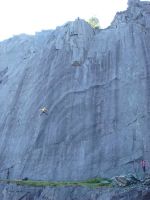
The moves to the first two wires are easy. Gear placed, the climbing is much harder now. Balancy moves, merest slate holds, but the initial crack is well protected and not worth agitating over. The plan is working well and movement flows, but now the route leaves the crack. An awkward step onto the rainbow demands a trump card: I visualise my foot made of glue and think myself light. The foot sticks and I'm at the rest beneath the crux sequence.
The last gear is two metres behind, over moves I doubt I can reverse. The next gear is almost ten metres ahead with the crux of the whole route yet to negotiate. I'm on a tiny ledge with no real handholds. I have to concentrate just to stay still. I need my toes to be as fresh as possible for the minuscule crux holds, but I can only recover by making subtle foot movements, temporarily resting a part of each foot in turn. I must maintain calm and focus whilst resting long enough to give a decent effort to the crux. Nevertheless, I knew I'd overcome this mental obstacle before I left the ground. How? Because I've been here before.
Thirteen days earlier I climbed to this spot with the sole intention of falling from the resting position. After the test-run, I know the gear will hold and I know what the swing feels like. If I'm overwhelmed, I know I can jump off in safety. There's a run-out ahead, but I've experimented from above too, dropping a rope to test for groundfall potential. If I fell from the worst position, rope stretch does mean I'd hit the ground. But the moves are easier by then, and I've briefed my belayer to start running if I need him to. All the unknowns are eliminated, bar one: whether I'll climb through the crux or fall off. I've already accepted both outcomes, so there's no reason to be anxious. Breathing under control, I begin the crux.
There are four or five desperate moves before things start to relent. Spellbound, I watch myself. Precise, confident moves and the hardest part of the route is done. The gear is a long way below now, and although not as hard as earlier, there's one more difficult move before much easier ground to the gear. I set up and commit, but as soon as I start to move, something's wrong. My left heel's too high. There's not enough rubber on the slate. Gravity won't let me get away with it. I'm off, falling, flying.
Why climb trad, folk at the wall ask, when there are such things as boulders and bolts? I don't know what answer to give when they point out that trad's for crazy fools. You must be insane, they say, to risk big falls onto dodgy trad gear. Yes, hard, run-out routes carry obvious risks, but there are subtle ones too, not least the risk of never trying the lead because you perennially think you should work the moves a few more times. At first the obvious outweighs the subtle and it would be inexcusable to attempt the route. But after a time studying, learning about the route, working on it, the balance shifts. Paradoxically, not trying becomes riskier than giving it a go. That's when it gets interesting.
Mid-flight, I switch to fall mode. I'd better orient myself to run down the slab as best I can. I've been airborne for so long that the rope must come tight any second. Before I can brace myself, the fall stops. I must surely be near the bottom of the slab, but my fingers are still on the same holds as when the fall began. It felt like the longest fall I've ever taken, but I've only dropped a couple of inches. As the left foot pops, the right slithers down to the previous epsilon it dared to call a hold. By a wretched miracle, it sticks, and the fall is over before it begins.
The spell remains intact. Breathing, body and mind are under control. I try again, I'm on the easier ground, here's the ledge and I've placed the gear. Chance for a shoes-off rest and then the joy of striding atop the rainbow to the stance, and pitch 1 is complete. Tied in, I pull up the rope and drop the end back down so I can be belayed from below for the rest of the attempt.
Pitch 2 is technically easier, but a single bolt, close enough to the belay to be clipped as part of the anchor, affords the only protection. After a good rest, it's decision time. Choices appear scarce: lower off, or commit to pitch 2. But there are almost always other options. You just have to understand that they really are options.
I know the hard climbing begins with an awkward foot-change, about a third of the way into the pitch. Forget the rest. My goal is just to make the foot-change. If it goes well, I'll decide whether to climb on or not. If it feels even slightly wrong, I'll jump off before I get any further from the bolt. It'll be a longish fall, but I'll be able to get back to the stance, recover, and try again.
At the foot-change, I'm focused on the immediate goal, not distracted by what may or may not come next. A clean execution, so I climb on. In a stable position, only one difficult sequence remains: a rockover with no real handholds. I shift weight, rock, maintain momentum, stand up. Hard moves done, I pause to enjoy the extent of the exposure. In my heart I know I'll finish it now. The ascent will be far from perfect, but it will be the very best I could manage on the day.
Up the final corner, I reach the finishing hold and instant disappointment. The adventure's over. The fun was the struggle, not its conclusion. But at least I have an answer for folk at the wall now. You don't have to be insane. What you need is a clear plan, some elementary skills to enact it, and a willingness to take the risk that it might just work.
June 8, 2013