


The H2H3K the Historical challenge.
By John Wild
Having read with an historical interest Jim Gregson's insert in the current Newsletter, and whilst having a great deal of respect for Jim's accuracy on many mountaineering affairs and that which includes KMC activities, I fear that on this issue he is somewhat mistaken. Well before we had purchased our Welsh hut, and when we still had our beloved "Irish Row", Coniston Hut, KMC activities in Wales needed to operate, frequently, from camping at "Little Willie's" farm in Ogwen. From there four of the then KMC membership organised this round - and without any support whatever.
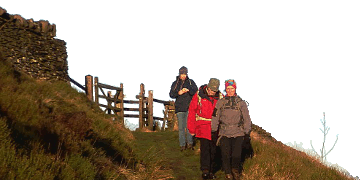
Myself, together with the then stalwart KMC member Alan Shepard completed the round beginning with the Glyders whilst the two others, I believe from memory to have been Alan Barber and Alan (L) Jones (although I can't be sure), completed the round in the opposite direction and beginning with the Carnedds. It was a very hot and tough round and I don't remember the time taken; we were quite satisfied to have successfully undertaken and completed the task from the campsite. We certainly didn't run, we did wear "big boots" and we did carry full day sacs with emergency gear. The Carnedds were considered to be very remote hills in those days. Tracks, mobile phones and GPS did not exist and sound mountaineering orientation skills were essential.
*I suspect that this must have been in 1969 or 1970 and before Jim joined the KMC as he and Sandy moved to Sale from Cleveland later. I see Jim only joined KMC in 1971 which might explain his historical "error".*
John Wild.
[Looks more like a memory challenge… Ed]
POST SCRIPT
Few of today's members will remember Alan Shepard, a devoted KMC member and a very sound and competent all round mountaineer. It was a shame that the issue of the siting of the club hut (Wales or the Lakes) needed to replace Irish Row (and which split the Club seriously at the time) caused his resignation as well that of others less well known. Again, few of today's members will remember the disputes within the committee on this subject and nor will they know of the outstanding work undertaken by John Castick and a few others who spent so many hours and drove so many miles in the attempt to find a suitable, potential property in either of the two locations being considered. John!s sterling work on the restoration and conversion of the Powder House to a habitable climbing club hut will be better known. This was not a glorious era in the Club!s history, nor of its committee at the time. I did sit on the committee and I did resign from it over the issue. None the less, I do not believe it should be forgotten. Out of the turmoil and trauma at that time emerged what the club now is and what its current property has become. Jim Gregson, with his interest in the documentation of important events past, might well consider accurately recording this shadowy period of the Club!s history, and of the doubtful proceedings of its committee, from the accounts of those few remaining members who were present at the time. All important and long standing Clubs have their history, positive in their Club!s evolution or otherwise. It is usually recorded somewhere. It seems to me that the KMC might at least consider doing likewise before it is lost forever, if only for posterity.