



Notes from a Holiday a Long Way Away
By Graham Harkness
I had another "big birthday" this year which, in part, was what made me remember that there was a whole hemisphere of this world that I had never visited, so almost on an impulse I booked a (solo) ticket for Singapore, Cairns to see the Barrier reef, Uluru, Tasmania, Christchurch then home. While I was away I did walk parts of some of the big wilderness trails in both Tasmania and New Zealand however on reflection I probably would have walked a full trail if I had been better organised. In case anyone is heading that way I thought I would share a bit of what I discovered. The main information is all on the tourist websites.
Tasmania is beautiful with a vast wilderness classed as a world heritage area, but the striking thing is that there are only 500,000 people on an island with the almost same land area as England. New Zealand is similar with only 1 million people on the South Island and again is world famous for its scenery.
In passing Uluru was fascinating. If you do go, it is worth a look at both Uluru and Kata Tjuta (the Olgas). I booked tours with an aboriginal company but most enjoyed taking the bus out to Uluru on my own and walking around the base. The rock is a hard sandstone compressed from granite based sand with a significant iron content.
The whole area is rusty which gives the striking red colour. There are many grooves and canyons on the rock which are clearly visible shadows, particularly at dawn. The local aboriginal culture, I was surprised to find, is about 40,000 years old. Their lore is oral, but remembered in the markings of the rock, which, it is said, were made by the ancient ancestors.
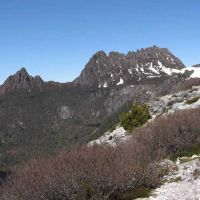
From Uluru I headed to Hobart, Tasmania. The best known area is the Cradle Mountain reserve and the Overland track. The track covers 60k of wilderness and is reckoned to take 6 days. However I met an English bloke at a hostel who had just nipped over from Melbourne and ran it in 2 days for a bit of relaxation, one of those mountain marathon men.
With the low number of people, public transport is very scarce so I decided to hire a car and drove the 250k to CRADLE VALLEY at the North end of the trail.
At the hostel in Hobart I met a couple of ladies who were doing the whole Overland track and they most forthrightly suggested that I could give them a lift, which I did. They had a cabin booked which saved me unpacking my tent, and they were good company.
I left the girls sorting out a boat pick up from the southern end of the trail and set out from Ronny Creek, near the cabin. You need the boat or else walk another 15 k along the lakeside. The Tassies are very safety conscious, even worse than me, and have books for walkers to check out to the fell and back in again. The weather could not have been better, a clear blue spring sky almost no wind.
The slight downside is that the Tassies are dead keen to preserve this pristine wilderness and strongly push you to stick with the very clearly marked trails. I followed the trail to the first hut and camped there, the location is called Waterfall Valley. The trail started across a bog very like parts of the Pennine way except in closer examination the plants are all different and the snakes come in 3 varieties about 1 meter long and deliver a seriously powerful neurotoxin if they take offence. Gaiters are advised for this reason but like all snakes if they sense the clumping of human boots they head off sharpish so you are lucky if you see one. I must admit I kept my boots inside the tent at night and had good shine around with torch before venturing out as one does after dark.
On the way into Waterfall Valley I stopped for an excursion up Cradle Mountain itself. On that side it rises steeply from the plateau for a few hundred meters but falls sharply for a long way on the back side. The summit is at first a steep walk and then a pleasant, easy scramble. Near the top it was necessary to cross a snow gully which was melting quickly and care was needed not to put a leg down between the rocks below.
The next day I walked the second leg of the trail to Lake Windermere, not a patch on the original. During that night the weather became more characteristically Tasmanian and it was pouring by dawn. I packed up walked out around the back of Cradle Mountain via the Scott Kilvert hut. With the great crags in the cloud and mist it was quite fairy tale. I walked all day and did not meet anyone until after lunch. My final diversion was over a high spot called Hanson Peak which afforded very good views of the whole area as the cloud conveniently lifted while I was on top. The way down was an easy scramble but the rangers had thoughtfully provided a bit of chain here and there to help. I did not object with the size of sack I was carrying.
In summary I found the people at the huts very friendly. I loved it when one kind soul popped in for a chat advised me by that "My Billy was boiling" and a moment later observed "yer got a load of tucker there mate".
If anyone is out near Australia and fancies the Overland track to start after the 1st November you have to book about a year in advance and pay around £90 for the privilege. Plus buy a National Parks Pass. The walking season starts on the 1st November and even in late October the huts were filling up. I chose to camp. I understand that the huts and the trail get busier as the season progresses. However if you go off the trail the expanse of moor and mountains is huge. I am not really sure what the official conservationist and rangers attitude is but I believe you are ok to go anywhere if you notify people of where you are going and a basically leave no trace. Do not cut paths and leave no signs of where you have camped.
To get there the most practical approach is to fly from Melbourne to Launceston in the north, not Hobart as I did. There are companies that will ferry you to the start of the track and pick you up at the end for a very modest fee. One I heard of was Tiger Wilderness Tours. Also remember that you need to book a boat out along Lake St. Clair if you want to avoid the last 15 K flog out Stow camping gear and boots near the top of your rucksack. The Aussies and New Zealanders are very strict on Bio Security even when moving from one state to another. My boots, big trainers and tent were emptied out and sterilised as I left the aircraft and they had sniffer dogs checking baggage for any food. You can carry processed food but almost nothing else. The best thing is to get rid of all fresh food before travelling. Both Australians and New Zealand officials are strict but do it with charm and humour, unlike some I have met.
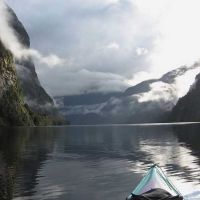
New Zealand was wonderful as many people have documented, but also very strict with bio security. I took a 2 day sea kayak trip in the fjord area down in the south west. The group were great fun and the scenery in Doubtful Sound stunning. Both Tasmania and New Zealand have reputations for very changeable weather but I was very lucky. The early morning view of these magnificent cliffs decorated with morning cloud was worth the trip. They have sand flies instead of midges which are not quite as irritating but the bites are nasty and lasted, on me, for about a month not the normal 1 hour for a midge bite.
Again to move around I found a car almost essential. I had six weeks in total but not so long in each place and did not want to take too long moving from place to place. I just booked cars locally and got better deals than booking in England. In any case car hire is generally a lot cheaper than in England. I found out that tourist information is supplied by a number of private companies that fund themselves by acting as booking agents, so they get deals for you.
The next journey was north to Mt. Cook village. There are three roads north in the South Island, East Coast, up the middle and West coast. A bit like the A1, M1 and M6 except that they are single carriage way. I drove up the middle (M1) and typically I saw another car about every 15 minutes.
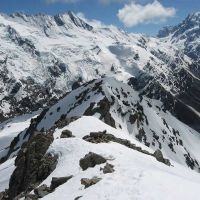
I could not climb Mt Cook on my own, but got some superb views from a walk up Hooker Valley. I also hired some crampons one day and plodded up Mt Ollivier. Not exiting by KMC standards but a most enjoyable alpine walk with dramatic views in air of a clarity I have only seen before in the arctic; and super avalanches crashing from the hanging glaziers, well away from my side I might add. Mt Ollivier is a bit famous as the first Alpine peak climbed by Sir Edmund.
The last stop was Arthur's Pass on the way back to Christchurch. My last little day out was a thing called Avalanche peak near Arthur's pass. An interesting place inhabited by big mountain parrot Keas (Nestor notabilis) that fly down to the camp sites and eat the rubber off your car.
The peak only took a couple of hours but I had it to myself in cloud that rose and fell during the morning. The top was a bit of an edge and quite atmospheric. Again an easy path with some snow near the top and a steeper bit of about 5 meters to kick up using hands and feet. On the way down it was like "The Birds" a dirty great parrot flew by nearly knocked me off and about 5 of them plonked down around me fearlessly staring, I suppose hoping for food.
And then it was off to Christchurch and a long trip home. Accommodation was very reasonable. I camped quite a few nights but less than I intended as single rooms in hostels were only in the region of £18 per night. I found YHA establishments were of a better quality than back packer hostels the notable exception being the Jail House in Christchurch. Eighteen months ago it was a "working" jail but now very well converted to a hostel. You could sleep soundly with a great steel door banged shut and locked (from the inside) behind you, and I sensed no ghosts in my cell.
I travelled with Quantas and I found them the best cattle class carrier I have flown with. The leg room, food and on demand inflight entertainment helped greatly, so did the fact I had a group of 3 seats next to the window all to myself for the long haul.
I was a great trip, a different experience as Sue did not come with me, and has certainly left me with itchy feet, I hear the upper reaches of the Ganges are interesting???
Graham Harkness.