


Roger's Old Nuts - Roger Dyke
By Roger Dyke
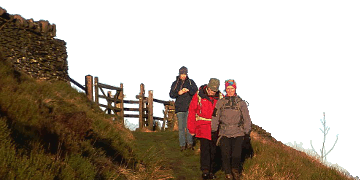
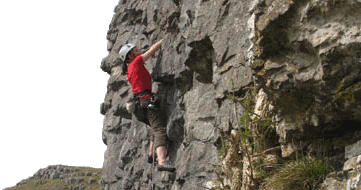
Yesterday at Stanage - 5 o'clock and the end of Chris Williams' Meet - everyone is going home except for a really keen [and very able!] 17-year-old newcomer, James. James is really keen to do more, so he and I head for High Neb to do a last couple of routes. He has brand new kit, so I borrow it to lead Tango Crack, which takes big gear.
James' colour-coded Rockcentrics really are a delight to slot in, and they made me think wryly of the gear Keith Bolton & I used in our early years - especially the big stuff.
 |
| Chocks that look like nuts |
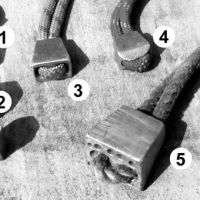
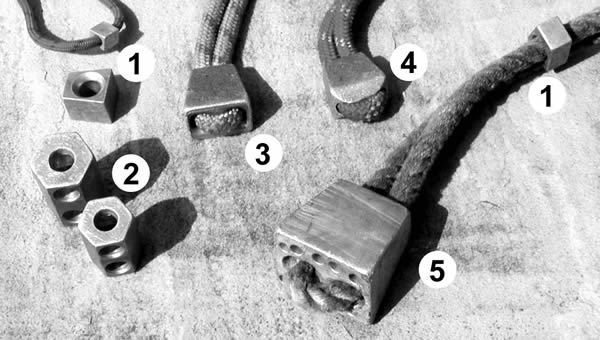
When Keith Bolton, Dave Booth and I started climbing, "gear" was still machine nuts with the thread drilled out, and drilled pieces of trapezoidal (1) and hexagonal (2) bar. The hex bar, especially when threaded with stiff hawser-laid rope and placed on its narrow dimension, was very good at falling out before you did.
MOACS (3) were just emerging, and were a great step forward: they were a handy size, a very effective shape, and took a full-strength rope.
Neville & I still spot 'Nice MOAC slot here'. But they were cast aluminium of doubtful strength, and in one size only, though you could file them down to (4).
I was working in an aluminium factory at the time, so we had unlimited high-quality raw material, and could make our own wedges in all sizes. The heaviest we made was (5). If you took this on a route, you tried hard to use it on the last pitch, so that on the way down it bruised your second's knees not yours. Keith was amazingly good at not having to carry it down.
It got us out of trouble one day when a nasty character tried to pick a fight with me at the [long-gone] Cromlech Bridge car park. Keith came up behind me swinging this horror and asking casually "Is there a problem?". The poor man's face dropped and he left without a word.
We came across him later with his mates in the Pad, but that's another story.
 |
| Big Chocks |
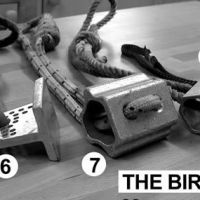
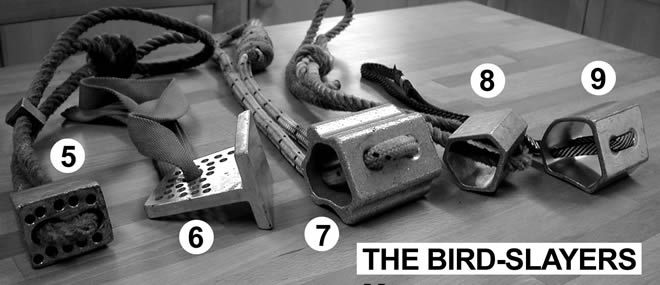
Trying to keep the weight down on larger sizes, we made (6) from truck-bed HE30 extrusion. This worked well, with three options for placing it so it fitted a good range of cracks. Cast big stuff emerged, and we picked up [someone had abandoned it on? perhaps Sabre Cut] (7), a triumph of the foundryman's art, but it wasn't a great help because neither of us wanted to carry it - 370gm - and it was too unwieldy for swatting fulmars anyway. So (6), at a mere 220gm, saw service until (8), cut from decent quality irregular-hexagon extrusion, came onto the market. Then a few years back I treated my self to (9), only 150gm, and with fancy curves that enable crafty souls to wedge it in so tight that by the time the second gets it out he is totally knackered.
We made small stuff as well, some of which I've kept for sentimental reasons.
 |
| Little Chocks |
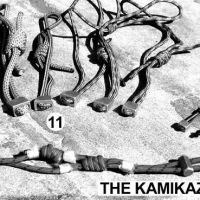
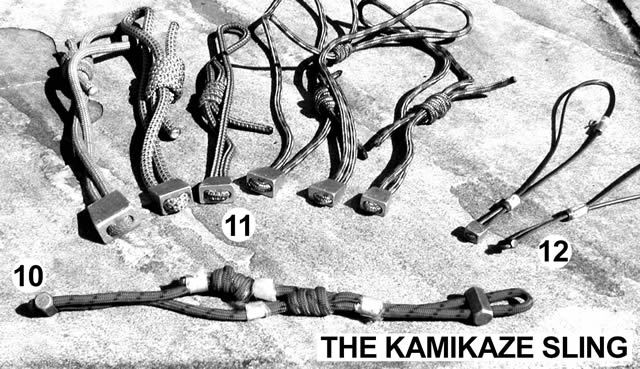
(10) has 1/2" hex bar at one end, 3/8" hex bar at the other, so was quite versatile. The two knots aren't an essential part of the design, just an economy measure, but if you think about it carefully they may make it a touch weaker than if there was only one - so Keith always referred to it as "the kamikaze sling".
Our (11)s were much better at staying in place than modern wires, but unfortunately they only took thin cord, so weren't nearly as good for spectacular falls.
We did have a very small version of (11), on thin yellow cord: this was the wedge referred to in Keith's famous "If you could see what I'm belayed to, you wouldn't fall off" on Wen. It's in the sea below Castell Helen if anyone wants it. Keith & I had finished Lighthouse Arête, and we just tied the rope round our waists in those days. So when Keith untied without stripping the gear from his waist first, what I'd put in on the top pitch slid down the grass and over the edge. After that Keith got a canvas belt he put the rope over, and I used about 8 turns of hemp round my waist, with a big iron krab for the rope. In 1971 I got a Willans Harnesses - great advance in safety and convenience - but Keith continued with his belt for some time. It was perfectly safe for him, because he never fell off.
After a year or so one quarter of my gear was commercial, bought by me. Another quarter was commercial, found abandoned on the crags, and half was home-made. Most of my krabs were still steel at the end of 1971, but don't laugh at steel krabs - unequalled for keeping slings on small spikes.
I remember Keith Bolton & I setting off from the garage at Tremadoc [now Eric's Café] in our tatty clothes - I remember my jacket had grown a sort of frilly 'keel' under one sleeve that weekend - with our hawser-laid rope and with our gear in a carrier-bag (practical, but not very macho). Someone we didn't know shouted to us "What are you going to do?", and Keith called back "Scratch Arête". There were peals of laughter, and even a kindly "I don't think so". SA wasn't done that often then. Pity they were gone when we got back - laugh was on them.
I bought a couple of wires (12) when they came out, but they did come out - with unfortunate ease - because the shapes were poor and quickdraws hadn't been invented.
Dave Booth & I thought about making camming devices for parallel cracks, but my calculations showed that none of the aluminium alloys available to us could stand the terrific compressive forces rolling cams would generate in a fall - very much higher than nuts - so we binned that idea. Mistake!!!
People climbed quicker in those days - if you don't have much gear, and what you have is limited to a narrow range of sizes, you don't spend long hanging about putting it in. The main pitch of Scratch at Tremadoc is an outstanding example. In the early 70's, there was nothing that would fit in the first 30 ft, so you laybacked smartly up the wide crack to that point. Nowadays, a determined and well-heeled climber can get five pieces in the first 15 ft. So it takes him far longer to lead the route. And if one of those is difficult to get out, the second is going to be exhausted so he'll be slower too.
Everyone is a lot safer now though, how did we survive? James, it was great fun to use your spanking new gear on Tango Crack, and I hope it serves you as well as my old tat served me.