


Around Annapurna
By Graham Harkness
An 18 Day Trek Encircling The Annapurna Conservation Area
I have recently returned from my first trip to Nepal. It is a fascinating and puzzling country with lovely people and spectacular scenery, but I guess that is not news to anyone.
I decided on the Annapurna circuit because it is a trek which provides a kind of “Nepal in a Nutshell” view of the various landscapes and a chance to meet with many people from the different regions. The Annapurna circuit is a lot more varied that the Everest Base camp trail and probably not quite so busy; but it is still one of the most popular treks in the world.
The organised trip I booked worked out well and not too expensive as the package included 4 nights in the Radison Hotel in Kathmandu, all food, porters and equipment, private bus transport and flights from the second city Pokhara back to Kathmandu. The itinerary was well practiced and included a day for sightseeing and orientation in Kathmandu plus excellent acclimatisation as we approached the high pass of Thorung La. I was still very short of air at 5400m but the acclimatisation was enough to avoid risk of harmful oedema.
We had an easy start with the day sightseeing in Kathmandu where there are a great many Buddhist temples and Stupas as well as major Hindu sights. I must admit feeling an intruder at the Temple of Shiva (the monkey temple) in this turmoil where people were cremating loved ones on big piles of wood, others having ritual meals for the recently departed, tourists wandering among it all and hoards of street vendors selling to tourists, and of course loads of monkeys. Certainly not the way they do funerals in Lanchester!
I looked and wondered about Kathmandu; it obviously had been built and developed at a time of some wealth. There were grand buildings, the roads had been surfaced and street lighting installed. Now the road surfaces are failing badly and side roads have very little surface left. Street lights do not work and many buildings are in a state of decay. Despite the chaos and smog the people that I met were all friendly and happy, possibly more so than in many parts of the UK, which is why I say I “wondered” about the place, it made an impression, it is different from anywhere else I have been.
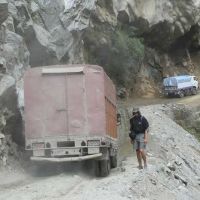
The trek proper started with a bus trip from Kathmandu to Bhulbhule, about 150k. The bus was a private hire and was manned by a driver and his “side banger man”. All large vehicles have this facility, a gentleman who leans out of the nearside door of the bus and sights down the driver’s blind side communicating one thump on the side of the bus to keep moving and two to stop as it squeezes through tiny gaps in the traffic. Drivers in different vehicles communicate to each other with a constant and intricate signalling system of horn sounds.
Progress was very slow because of the heavy traffic. We turned off the main Pokhara highway at Dumre to Besi Sahar and headed north up the Marsyangdi Nadi (valley).
The bus driver’s skill and concentration were to be admired. The last 15k was an education for me. There is one un-surfaced track to Bhulbhule and at that time I personally would not have considered it feasible to drive anything along it, but it is a bus route and he took our ancient Tata bus up to the village; 8 hours to cover 150k.
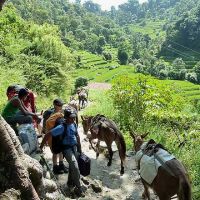
The trek area has a substantial population with small communities almost every hour. The track is also well used by donkey trains, local people, buffalo and so on. Those first days were very hot as we climbed fairly gently through beautiful forests, rice paddy and great scenery.
As we passed through the Marsyangdi Gorge we also started to get views of the big hills, enormous snow covered peaks Kangaru on one side and Annapurna 2 to the west.
For the first 4 days we were walking around 6 hours a day but as we got up towards the 3000m level, walks between camps were shorter with an afternoon excursion up another few hundred meters to a viewpoint or temple. We returned to sleep at the lower level. I had no shame in going dead slow as we got higher. I started at the back and invariably had more than half of the party behind me at the end of the day.
I was the oldest in the group but seemed to be most experienced in mountain walking. The others were all fitter and slimmer but seemed to find it hard to slow down as the air got thinner.
My acclimatisation apparently worked as I did not need any pills of any sort whereas the others were all popping headache pills, going to bed with a Diamox tablet and enjoying regular bouts of “gastro”.
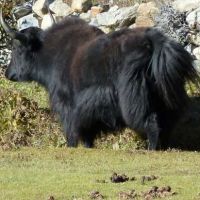
We camped sometimes on private campsites and sometimes common land, which we had to share with the football pitch, donkeys, yaks, naks and buffs. As the ageing person goes higher the pee rate increases dramatically. Lying wanting a pee but hearing some heavy breathing yak inches away on the other side of the canvas was not restful. I was forced to creep out, take a good look around but seeing a black yak in a black night is hard, you listen intently for the little bells, pee dead quick and dive back in before being run down by a galloping half ton animal (with horns). For some reason these beasties do not stand still and graze quietly. They run around, snort fiercely and stick their horns up other beast’s arses. After that I invested in a North Face lookalike bottle to save leaving the tent during the night.
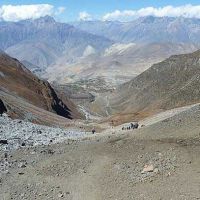
The scenery became more dramatic; we passed massive sweeping rock faces and indescribable views of Annapurna 2 and 4 then later Annapurna 3 and Ganggapurna. The valley seemed to have been a great glacier at one time. The moraines were hundreds of metres deep and water washed into convoluted ridges and gullies. The sun began to burn more and the amount of dust in the air increased so I joined the locals and covered my head mouth and nose. The others in the party thought this an improvement!!
The Nepalese view of life is far more down to earth than ours. Small children run about, as far as we could tell, unsupervised. Boys of about 8 herd huge buffalo and we saw a child of about 4 or 5 deftly sharpening the end of sticks using a Ghurkha knife with a blade about a foot long and half an inch thick while his older brother about 8 made a long beautifully straight cut down a plank of wood with a large rusty saw.
Then onward, swinging westward and upward to Yak Kharka, and further to Thorung Phedi at the base of the pass. The camp site was at 4500m, the terrain now pretty much bare rock and scree. For the last couple of nights I had slept well for a while but then had to wake up to take a few extra deep breaths; sort of pump myself up and then nod off again.
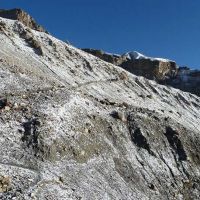
Thorung La was a long day. It snowed overnight so after daybreak the world had an attractive white icing. We set off in the dark, as you do, feeling sick, head torch on forcing down food you don’t want and thinking those private thoughts. My progress was painfully slow, I moved in half steps pulling in freezing air. As always, dawn was most welcome. I now have nothing but awe for those hardy souls that go far higher and still have the energy to tackle difficult technical climbs.
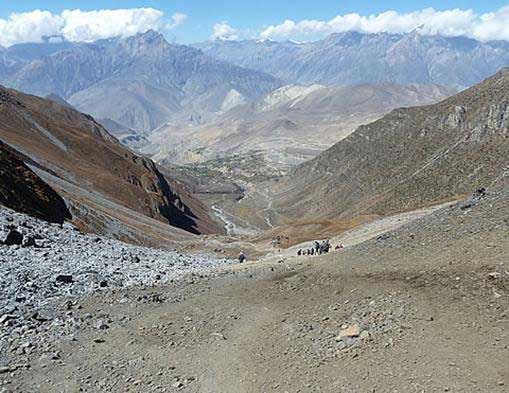
The west side of the pass is totally different from the eastern approach. It is a long not too steep desert more like the centre of Australia. As we went down in the afternoon the famous wind got going driving dust into our faces so time to cover up again.
We camped that night at Muktinath, which is the end of a vehicle road that eventually winds its way back to Pokhara. We had to follow this for a couple of days first to Jomsom and then eventually to Tatopani. Once we were clear of the higher gaunt windswept valley the country became very rich with orchards and many types of fruit and vegetables growing. A lot of Tibetan refugees have settled there over the years. The Buddhist temples and monasteries were beautiful and generally the villages had a better kept appearance with almost no litter on the streets.
Now heading South east from the road and up through classic Himalayan scenery we headed for Ghorapani and the famous view point of Poon Hill. Up and up steep paths that turned into the endless stair, very hot and humid and then the rain started, first time all trip.
We set out before dawn next day for Poon hill. It had been a clear starry sky when we awoke but by the time we were half way up we were in thick clag and no sign of improvement. It was not too much of a disappointment because after that we stayed high for a good while and did see magnificent views to the north but I don’t think we did ever actually see Annapurna 1, 8091m, which was hidden in the clouds.
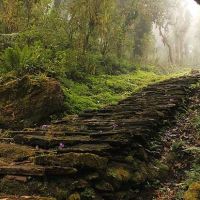
It was downhill all the way now, next camp was at 2600m on the edge of a Rhododendron jungle.
Then came a long, long stair down into the valley, Modle Khola. Near the bottom we saw fresh clean trekkers just starting up. We, the travel stained, smiled and greeted them but said nothing, it was going to be a hard way up for them. We had only one more fairly easy day along the valley to our final camp before Pokhara. To end the trek my fit friend had a final bout of projectile vomiting which I only avoided due to my cat like reactions. We did have a day to clean up in Pokhara, which for my taste is a far more pleasant place than Kathmandu. From there we went by bus and plane back to Kathmandu.
We had walked steadily for some 17 days, I had avoided all forms of illness, eaten heartily and still lost a stone in weight. The scenery and culture very different from anything I had seen before and I had most excellent company, even if they were mainly colonials. My room/tent mate was an excellent young man of 30 years who did magnificently to put up with a reactionary old git more than twice his age, I learned much from him. Not a difficult mountaineering trip but a good walk and a great view of a strange land with wonderful people.